Signals of Care — How It Works
How sustainability signals are gathered, classified, and surfaced on winegrower pages.
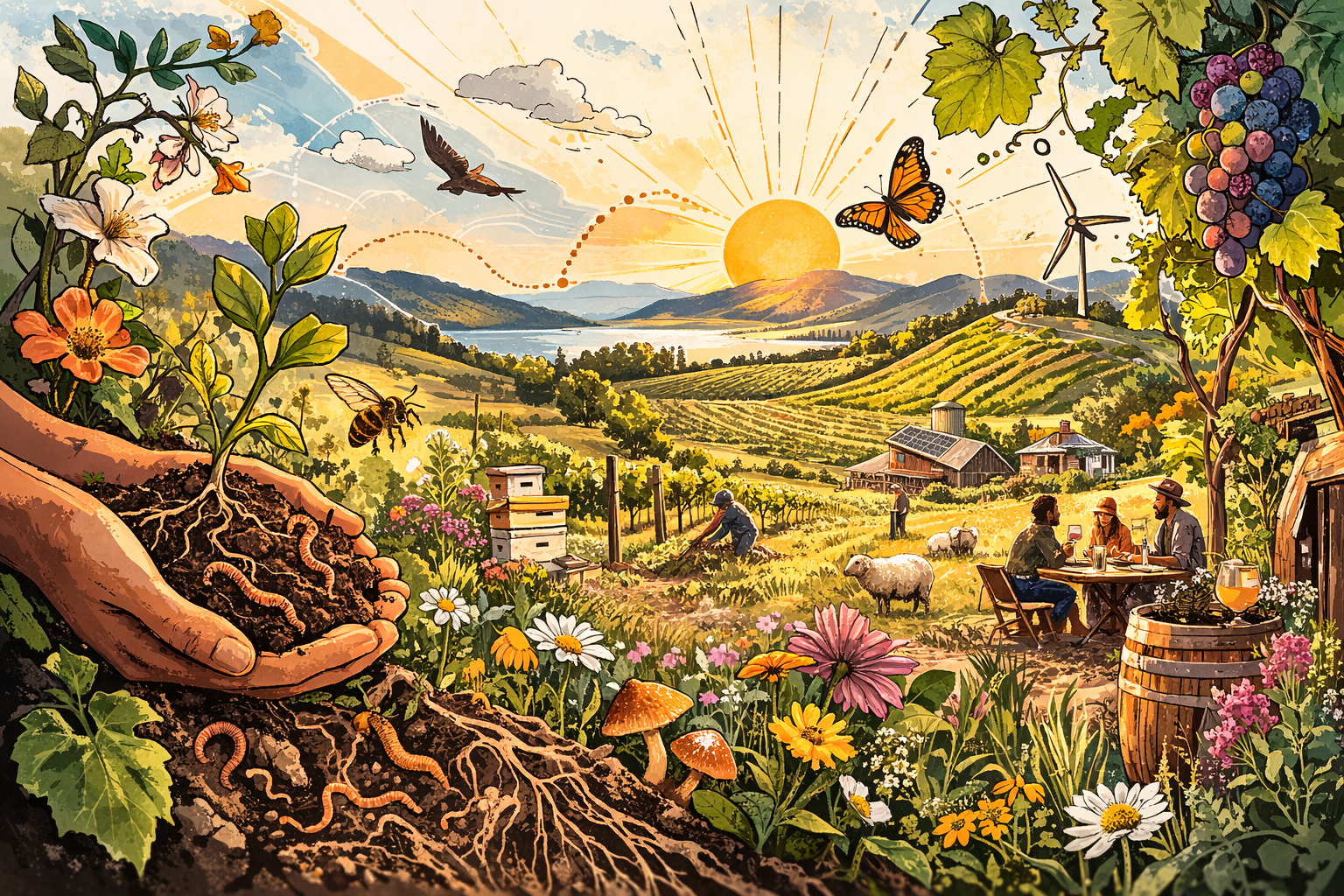
The Signals of Care section on each winegrower page surfaces sustainability practices found on their website and in public sources. Here's how it works.
The goal is simple: make it easier to discover winegrowers who are putting in quiet, real effort — and to connect people who share similar approaches. Not a certification board, not a ranking. Just a way to find your people.
What Are Signals?
A signal is a practice or commitment found on the winegrower's own website or in public sources — press coverage, directories, certifications databases. Each signal carries a direct citation from the source, so you can read it in context.
Signals include certifications where AI found a claim by the grower. We do not run any independent verification — a "certified organic" signal is an AI conclusion based on what was found publicly, not a confirmation that the certification exists or is current.
How They're Gathered
For each winegrower, an AI model (GPT-5) reads their website and public mentions, then extracts structured signals using a fixed vocabulary — the taxonomy below. The prompt is the same for every winegrower. The model returns term + citation + URL for each signal it finds.
For Quebec producers, the research favors French-language sources. Citations preserve the original language.
The Signal Taxonomy
All signals map to one of 6 categories and ~176 canonical English terms:
- Formal status — certifications and labels (organic, biodynamic, regenerative, sustainable)
- Vineyard practices — inputs, soils, biodiversity, water, cover crops, pest control
- Cellar practices — yeast, sulfites, fining, filtration, fermentation vessels
- Positioning language — natural wine, low-intervention, beyond-organic
- Resistant grapes — PIWI, disease-resistant hybrids, hybrid strategy
- Social / ecological framing — stewardship, ecosystem, community
The page displays only the first four categories as lenses. Positioning and social framing signals are collected but not shown — they're softer claims that rarely add signal on their own.
Hybrid Variety Signals
One signal type is computed differently: the share of hybrid varieties in a winegrower's portfolio. This comes from our own wine and variety data — not web research. For winegrowers with 2 or more known varieties, we count how many are interspecific or cold-climate hybrids vs. total, and assign a term accordingly ("some", "mixed", "mostly", or "all hybrid varieties"). The citation is descriptive (e.g. "8 of 10 grape varieties are interspecific hybrids") with no source URL since it derives from internal data.
What Signals Are Not
To be clear about what this section does not do:
- Not a score or rating — there is no ranking of winegrowers by sustainability
- Not verification — we do not audit certifications or confirm claims
- Not exhaustive — AI may miss signals that exist; absence is not absence of practice
- Not a recommendation — signals describe what a winegrower says, not what we endorse
Limitations
AI classification is imperfect. The model may miss signals buried deep in a website, misread context, or map a phrase to the wrong taxonomy term. Citations are included precisely so you can double-check. If a signal looks wrong, follow the link.
Coverage also depends on how much a winegrower publishes online. Producers with minimal web presence will have fewer signals — not because they do less, but because we found less.
How Similar Winegrowers Works
The Similar Winegrowers section ranks other producers by a combination of shared sustainability signals (weighted 2×), shared grape varieties, and geographic proximity. Proximity adds a bonus that decays with distance, so a nearby grower with some overlap can rank above a distant grower with more overlap.
Clicking a signal chip shows other winegrowers who share that specific term, ranked by total signal overlap and proximity.